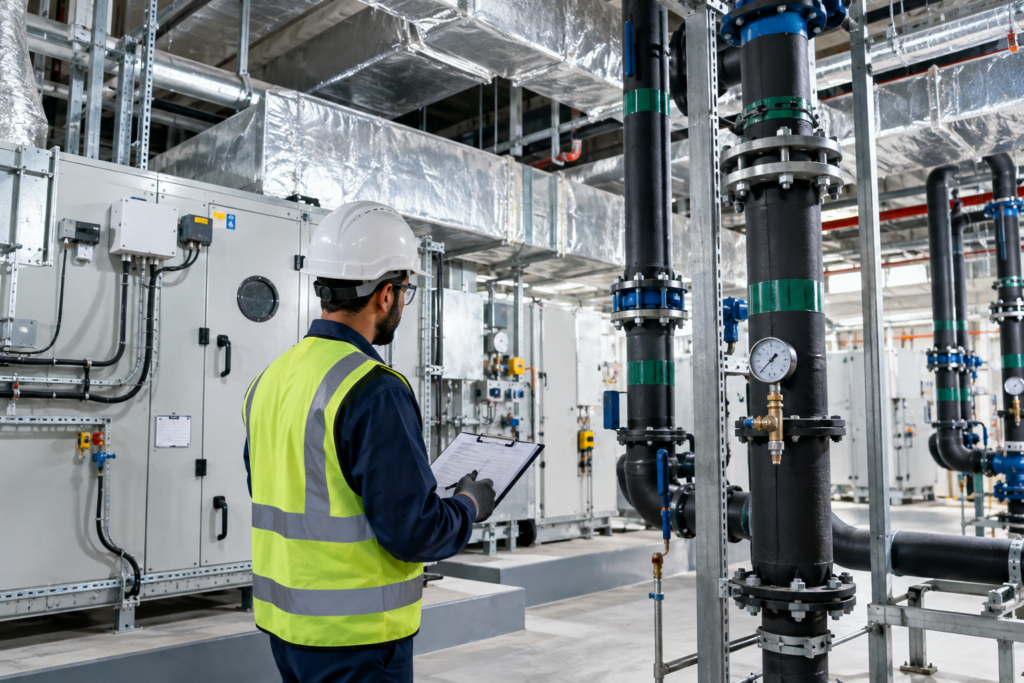
Handover delays rarely come from one dramatic failure. They usually come from a long list of small issues discovered late: a valve left closed, a sensor wired to the wrong point, a report that cannot be signed because data is missing. Each one is simple on its own. Together, they can hold up a project for weeks.
This checklist is written for MEP contractors who want systems ready for commissioning the first time, with fewer repeat tests and a cleaner path to handover.
Before installation is complete
- Confirm the commissioning plan. Know which systems will be tested, in what order, and what the acceptance criteria are.
- Check access. Dampers, balancing valves, test points and control panels must be reachable once ceilings and shafts are closed.
- Install test points. Pressure and temperature test points, flow measuring stations and duct test holes should be in place as specified.
- Keep submittals and as-builts current. Commissioning relies on accurate drawings and approved equipment data.
Pre-commissioning checks
- Pressure testing and flushing of chilled water, condenser water and other piping systems completed and recorded.
- Duct leakage testing carried out where specified. See our duct leakage testing service.
- Ductwork cleanliness confirmed before systems run, with filters installed. Duct cleaning may be needed if ductwork was left open during construction.
- Equipment start-up completed by manufacturers or approved technicians, with start-up reports available.
- Rotation and electrical checks done on motors, fans and pumps.
More detail on this stage is on our HVAC pre-commissioning page.
Ready for TAB
- All dampers and balancing valves are installed, open and accessible.
- Terminal units, diffusers and grilles are installed and connected.
- Fans and pumps run reliably, with VFDs configured.
- Building openings that affect pressure, such as doors, windows and shafts, are closed or in their final state.
- Controls can hold systems in the operating modes needed for balancing.
Starting testing, adjusting and balancing before these items are ready almost always means repeating the work later.
Ready for functional performance testing
- TAB is complete and deficiencies have been addressed.
- Control sequences are fully programmed and point-to-point checked.
- Sensors are calibrated and reading correctly.
- Alarms and safeties are configured.
- Interfaces with fire alarm, generators and other systems are connected.
Fire fighting and life safety
- Fire pumps tested and controllers set.
- Sprinkler and standpipe systems flushed and pressure tested.
- Interfaces with fire alarm, smoke management and HVAC shutdown verified.
See our fire fighting commissioning page for how we approach these systems.
Electrical systems
- Switchgear and distribution boards tested, with protection settings applied.
- Generators and transfer switches ready for load testing.
- UPS systems installed and configured.
Documentation for handover
- Completed checklists and test records for every system.
- TAB report reviewed and accepted.
- Deficiency log with every item closed out and evidenced.
- Operation and maintenance manuals and as-built drawings.
- Training records for the facility team.
The biggest time-saver: involve commissioning early
Contractors who bring the commissioning team in early avoid most of the problems on this list. Issues are spotted while they are still cheap to fix, testing is scheduled realistically, and nobody is surprised in the final weeks.
TABCOMM works with MEP contractors across Saudi Arabia to get systems tested, balanced and handed over. Contact us to plan commissioning for your next project.


